

What Is A Place Value Drawing
Place value
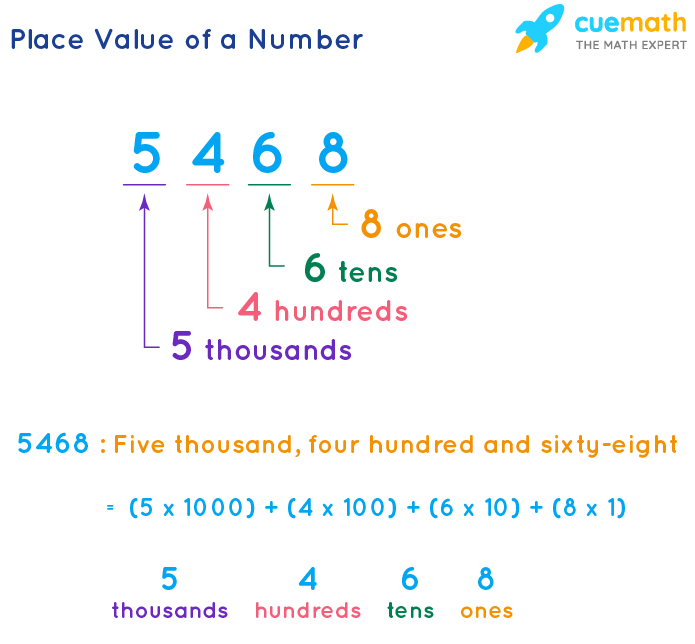
Place value in Mathematics describes the position of a digit in a number. Each digit has some value in the number, depending upon its position. When a number is represented in the general form, the position of each digit will be expanded. These positions start from a unit place or ones position. The order of place value of digits in a number from right to left is ones/units, tens, hundreds, thousands, ten thousand, a hundred thousand, and so on.
| 1. | What is Place Value? |
| 2. | Place Value Chart |
| 3. | Place Value Chart with Decimals |
| 4. | Face Value in Maths |
| 5. | FAQs |
What is Place Value?
Place value is the value of each digit in a number. The value of every digit in a number is different based upon its position in the number. A number might have two similar digits but with dissimilar values, which is decided by the position digit holds in the number. Place value is the value of a digit according to its position in the number such as ones, tens, hundreds, and so on.
For example, 5 in 3458 represents 5 tens, or 50. However, 5 in 5781 represents 5 thousand or 5,000. It is important that you understand that a digit can be the same, but its value will depend on its position in the number.
Example: Write down the place value of each digit in the number 543.
Solution:
The correct place value of each digit in the number can be given as:
- 5 × 100 = 500
- 4 × 10 = 40
- 3 × 1 = 3
Place Value Chart
Place value charts help us to make sure that the digits are aligned in the correct places. Place value displays the correct position or place of a digit in a number. To identify the positional values or worth of different digits in a number accurately, firstly, write the digits in the place value chart and then write the numbers in the usual and the standard form.
The 10 digits we used to represent the numbers are:
| 0 | 1 | 2 | 3 | 4 | 5 | 6 | 7 | 8 | 9 |
In this chart, we can observe the place value of numbers. On moving towards the left we observe that the value of every successive place becomes 10 times that of the previous one. The value of every successive place on moving toward the right becomes 1/10th of the previous one.
We can refer to the International or Indian place value chart based on the numeral system both the charts follow. The Indian place value chart is based upon the Indian numeral system, while the International place value chart is based upon the Internationally accepted numeral system. The main difference between the Indian and the International numeral system is the placement of the separators (commas) and the nomenclature of different place values.
Indian Place Value Chart
The Indian place value chart is a table that is used to find the value of each digit in a number based on its position, as per the Indian numeral system.

International Place Value Chart
The International numeral system is used worldwide in which we count in terms of ones, hundreds, thousands, ten thousand, hundred thousand, millions, and billions.

Printable Place Value Charts
Memorizing and solving problems on place value systems becomes easier using a printable place value chart. These charts have place values printed in tabular form across blank spaces for each digit in a number. While referring to these charts for solving a problem, we can directly place the digits in their respective position according to the one in the number and evaluate their place values accordingly.
Place Value Chart with Decimals
A decimals number system is used to express the whole numbers and fraction together. Here, we will separate the whole number from the fraction by inserting a ".", which is called a decimal point. If we go right from the ones' place, the next place will be 1/10 times smaller, which will be 1/10thor one-tenth position. In this chart, we can observe the place value of decimal numbers.
- Place value depicts how much each digit stands for in a number.
- Use a hyphen whenever you use words to write 2-digit numbers that are greater than 20 that have a digit other than zero in the ones place.
- A place-value chart depicts how many hundreds, tens, and ones to use.

Face Value in Maths
The face value of a digit in any number is the value of the digit itself. Whether the number is single-digit, double-digit, or any number, each digit has its face value. Let us understand using examples.
- For number 4, 4 is the face value.
- For number 78, the face value of 7 and 8 are 7 and 8 respectively.
- For 52369, the face value of 3 is 3.
Difference Between Place Value and Face Value
Place value describes the position of a digit in a given number. On the other hand, face value describes the value of the digit. Let us take an example of a number say, 1437. The table given below explains the difference between the place value and the face value of digits in this number.
| Digits | Place Value | Face Value |
| 1 | Thousands (1 × 1000 = 1000) | 1 |
| 4 | Hundreds (4 × 400 = 400) | 4 |
| 3 | Tens (3 × 10 = 30) | 3 |
| 7 | Units or ones ( 7 × 1 = 7) | 7 |
-
Example 1: Fill in the blank with the missing place value in the expanded form of the given number. 500 + ___ + 1 = 591.
Solution:
The missing number is 9, and the place value of 9 is 9 × 10 = 90. Therefore, the missing place value is 90.
-
Example 2: A number has 4 thousands, 7 hundreds, and 8 tens. What is the number?
Solution:
The place value of the following numbers are:
4 thousands = 4,000
7 hundreds = 700
8 tens = 80
Adding these numbers together, we get: 4,000 + 700 + 80 = 4780. Therefore, number is 4780.
go to slidego to slide

Create logical thinkers and build their confidence!
With a flexible curriculum, Cuemath goes beyond traditional teaching methods. We make math exciting. Check out how!
Book a Free Trial Class
FAQs on Place Value
What is Place Value? Give Example.
Place value is the value of each digit in a number. The value of every digit in a number is different based upon its position in the number. A number might have two similar digits but with dissimilar values, which is decided by the position digit holds in the number.
For example, the place value of '1' in the number 8991 is 1.
What is the Place Value of 6 in 64?
The place value of 6 in 64 is 6 × 10 = 60.
How Place Value is Different from Face Value?
The place value represents the position of a digit in the number whereas the face value gives the exact value of a digit. For example, in 2003, the place value of 2 is thousands whereas the face value is 2 only.
What is an Example of Place Value?
Place value represents the worth of a digit in a number. Examples of place value are:
- The place value of 2 in 24 is 2 × 10 = 20.
-
The correct place value of each digit in the number 543 can be given as:
5 × 100 = 500
4 × 10 = 40
3 × 1 = 3
What is the Place Value of 5 in 50?
Place value is the value of each digit in a number. The place value of digit 5 in 50 is 5 × 10 = 50.
What is the Face Value of a Number? Give Example.
The face value of a digit in any number is the value of the digit itself. For example, the face value of 7 in 2769 is 7.
What is a Place Value Chart?
The place value chart is a table that is used to find the value of each digit in a number based on its position, as per the numeral system.
How to Make a Place Value Chart?
To make a place value chart, follow the steps given below:
- Step 1: Draw columns showing different periods according to the type of numeral system: ones, thousands, and so on.
- Step 2: Under each period, draw sub-columns to show the different place values.
You can refer to the Indian place value chart and International place value chart in the above sections for the different periods and place values of a digit in a number according to the type of numeral system.
Why is the Concept of Place Value Important?
The concept of place value is important because it gives the worth of every digit in a number according to its position.
What Is A Place Value Drawing
Source: https://www.cuemath.com/numbers/place-value/
Posted by: jamesheremer.blogspot.com
0 Response to "What Is A Place Value Drawing"
Post a Comment